Oregon Fleets Go Electric Together as State Launches New eFleet Network

Oregon’s effort to electrify the vehicles that keep the state running — delivery vans, work trucks, garbage haulers and buses — picked up new momentum last week, when the Salem-based Oregon Department of Energy launched a statewide network designed to help fleet operators make the switch to electric power together instead of one costly experiment at a time.

The Oregon Electric Fleet Network, which the agency is calling the eFleet Network for short, was created by ODOE in partnership with the Oregon Department of Transportation, the Oregon Department of Environmental Quality and the National Association of State Energy Officials. It starts with a founding group of 24 fleet operators drawn from both the public and private sectors, according to the department’s Sept. 30 announcement.
Members held an in-person kickoff on Sept. 29. From here, the group plans to meet virtually on a regular schedule so fleets from every corner of the state can take part. The idea is simple: fleet managers share what has worked and what hasn’t, so the next agency or company doesn’t have to repeat the same mistakes.
The stakes are significant. Transportation is the largest source of greenhouse gas emissions in Oregon, and ODOE says fleet vehicles — from state and local government cars and trucks to school buses, transit vehicles and commercial delivery vans — offer one of the biggest opportunities to cut them. Fleet managers also tend to run into the same obstacles when they go electric: uncertainty about charging, higher upfront costs, figuring out which incentives are available and finding the right vehicles.
“Fleet operators across Oregon are working through similar questions as they plan for an electric future — and there’s a lot of value in not having to solve those problems alone,” said ODOE Director Janine Benner. “The Oregon Electric Fleet Network gives fleet managers a place to learn from each other, share what’s working, and move forward with more confidence and less trial and error.”
Benner added that electrification, including vehicles, is one of five pathways in the Oregon Energy Strategy for meeting the state’s energy and climate goals. ODOE says it hopes the network will speed up fleet electrification statewide, help members take full advantage of available funding and unlock the operating savings that electric medium- and heavy-duty vehicles can offer. When the agency first previewed the project in June, it said the network would also create a two-way conversation so state programs better reflect what fleets actually need on the ground.
To mark the launch, the State of Oregon and Portland General Electric hosted a Fleet Forward Electric Ride and Drive at Portland International Raceway the same day as the kickoff. More than two dozen electric vehicles were on hand for test drives and display, ranging from delivery vans and medium-duty work trucks to refuse trucks, motorcoaches, yard tractors and Class 8 freight trucks. An electric John Deere tractor and two mobile charging units rounded out the lineup, with models from Tesla, Rivian, Volvo, Mack, Daimler, International, Isuzu, Harbinger, Workhorse, Chevrolet and others.
The fleet push comes as everyday Oregonians keep plugging in, too. The Source Weekly in Bend reported last month that nearly 8,000 EVs are now registered in Deschutes County, according to the state’s Electric Vehicle Dashboard — roughly double the 2023 figure. That works out to 38 EVs per 1,000 residents, the fifth-highest rate in Oregon. “Compared to a lot of the rest of the United States, it’s very strong adoption trends,” ODOE technology and policy manager Jessica Reichers told the paper.
There is still ground to cover. Statewide, Oregon has about 140,000 electric cars, short of the 250,000 goal the state set for 2025, the Source reported. Registrations dropped after federal rebates expired last fall, Reichers said, before ticking back up as gas prices climbed.
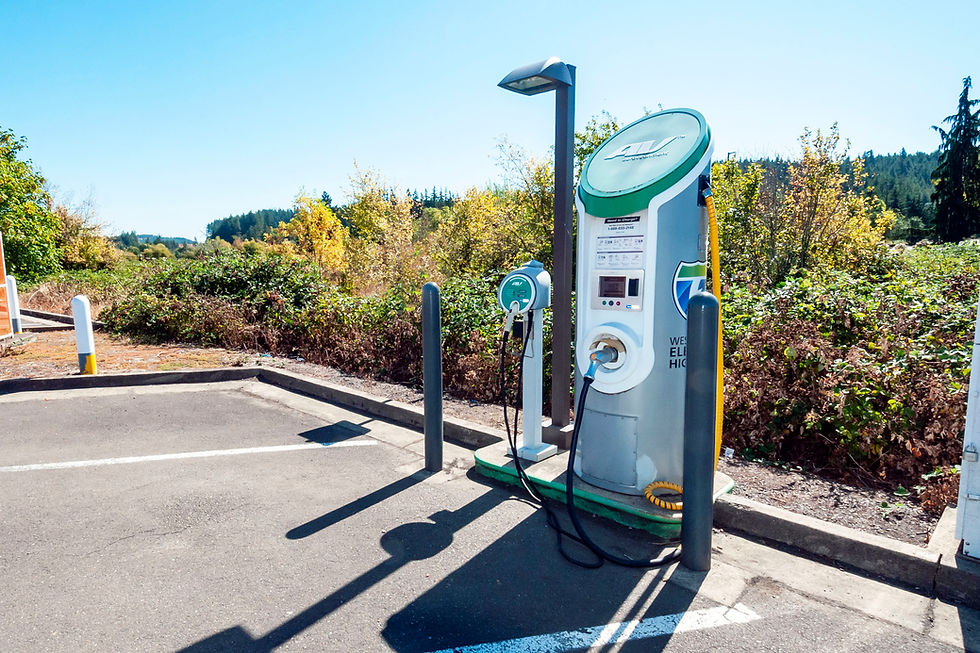
More public charging is on the way as well. On Oct. 1, ODOT opened Round 5 of its Community Charging Rebates program with about $5.5 million available. For the first time, DC fast-charging projects qualify, with rebates of up to $80,000 per fast-charging port and $8,000 per Level 2 port, or 80 to 95 percent of eligible project costs, whichever is lower. Funds are awarded first-come, first-served — and the previous round closed in January because of high demand.
For Willamette Valley cities, school districts and businesses weighing whether to electrify their own trucks and vans, the message from Salem is that they won’t have to figure it out alone. More information about the network is available from the Oregon Department of Energy at oregon.gov/energy.
Thinking about going electric at home?
If the fleet news has you weighing an EV of your own, home charging is usually the first thing to sort out. A Level 2 charger on a 240-volt circuit charges much faster than a standard wall outlet. Popular options include the Grizzl-E Classic, a rugged plug-in model with no app to manage, and the Emporia Pro, which balances its load for homes with limited electrical service. To bring Level 2 charging along on trips, the Lectron portable Level 2 charger plugs into a NEMA 14-50 outlet. For adapters, accessories and more picks, see our EV Gear Guide.
As an Amazon Associate, Willamette News earns from qualifying purchases. Buying through these links supports local news at no extra cost to you.
Sources: Oregon Department of Energy, “Oregon Department of Energy Launches Oregon Electric Fleet Network to Accelerate Fleet Electrification Statewide” (Sept. 30, 2026); Oregon Energy Strategy, “Peer-to-Peer Network for Medium- and Heavy-Duty Electric Vehicle Fleets” (June 2026); The Source Weekly, “EVs Boom in Central Oregon” by Clayton Franke (Sept. 23, 2026); ODOT, Community Charging Rebates Program.
Photos: Cover — an EV driver charges at a fast-charging station at Mt. Hood Skibowl, by the Oregon Department of Transportation via Wikimedia Commons, CC BY 2.0. Inline — TriMet electric bus by Ac530 via Wikimedia Commons, CC BY 4.0.


Comments